
Portfolio › Grow
Grow: 1,000 boxed board games for New Zealand classrooms
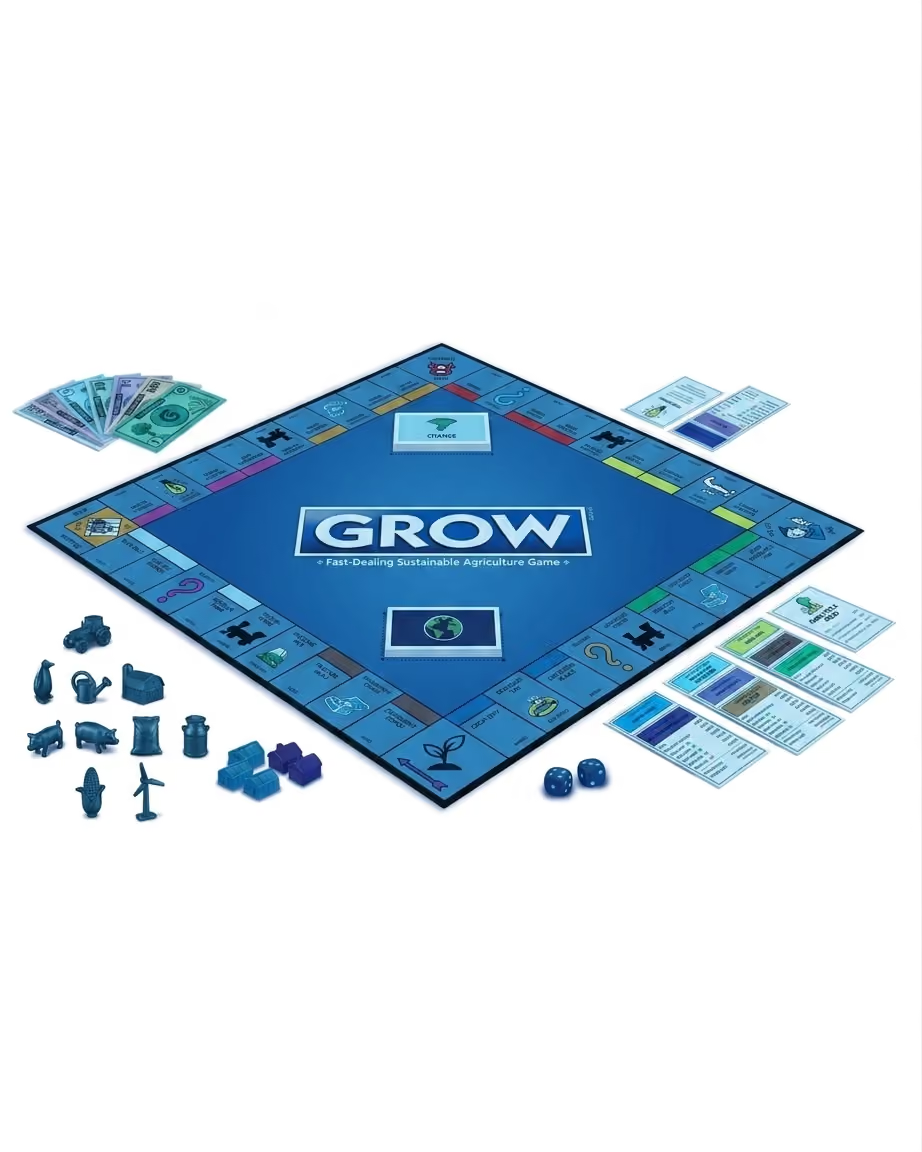
An agribusiness board game built for the Year 11 NCEA curriculum — money, boards, cards, tokens, a cloth bag and a rulebook, collated into a thousand complete sets and delivered to schools around the country.
The brief
Rabobank, Lincoln University and Agribusiness in Schools wanted a board game that taught the Year 11 NCEA Agribusiness and Agricultural & Horticultural Science curriculum by having students actually play it — running a farm, making decisions, living with the consequences.
A teaching resource has a constraint most games don't: it has to arrive before the term it's meant to be taught in. The date wasn't negotiable, and a thousand schools' worth of boxes can't be half-finished on the day.
What's in the box
A board game isn't one product, it's eight or nine arriving at the same time and fitting together. Grow needed:
- Game board — 2mm greyboard, wrapped in 128gsm paper with a semi-matt laminate
- Box — same construction as the board, so the finish matches when both are on a desk
- Paper money in multiple denominations
- Player boards, one per player
- Game cards for the decision and event decks
- Punchboard tokens, die-cut so they push out cleanly
- Cloth bag for the tokens
- Rulebook
The semi-matt laminate matters more than it sounds. A classroom set gets handled by a different group every period, all year. Gloss shows every fingerprint and scuffs at the fold; semi-matt takes the abuse and still reads clearly under fluorescent light.
Made here, except the board and the box
We want to be straight about this, because we think it matters more than a marketing line.
Everything except the game board and the box was made in New Zealand — the money, the player boards, the cards, the punchboards, the rulebook. Those two items came from our supplier in China, for one reason: size. A wrapped board and box at those dimensions were beyond what could be produced here at that quantity.
Then all 1,000 sets were assembled and finished in New Zealand. Collation, boxing, checking — every one of those boxes was filled here.
That split is also why the job took six weeks rather than the two or three a fully local run would need. Sea freight on the boards and box set the timeline, and we planned backwards from it rather than promising a date we couldn't hold.
The shrink wrap problem
Here's a wrinkle nobody plans for. Chinese manufacturers won't release finished goods without shrink-wrapping them first — it's simply how product leaves the country.
Which meant a thousand empty boxes arrived sealed. So we unwrapped every one, placed the components inside, and re-shrink-wrapped the lot.
It's a small thing, and it's exactly the sort of small thing that turns into a very long week if you find out about it late. We knew, so it was built into the schedule instead of eating it.
Why this kind of job suits local manufacturing
With a deck of cards, going offshore is mostly a question of time and minimum order. With a boxed board game it's a question of risk, because there are eight things to get wrong instead of one.
A board that doesn't fold flat, tokens that don't punch cleanly, an insert that doesn't fit — you want to find that out from a sample on a desk, not from a container that's already crossed the Pacific. Handling assembly here also meant that when a thousand sets had to be checked and boxed to a fixed date, the people doing it were reachable by phone.
See board game manufacturing for how we approach this kind of production, or game prototype printing if you're still testing the rules.
Making yours
Send us the component list — every physical item in the box, with dimensions if you have them — plus the quantity and your deadline. We'll tell you what we make here, what we'd source, and what the timeline realistically looks like, before you commit to anything.
Got a boxed game to produce?
Tell us the component list and how many sets you need. We'll come back with a price and a timeline you can plan around.
Request a quote