
Portfolio › Go Phish
Go Phish: a playing card deck for a New Zealand video game
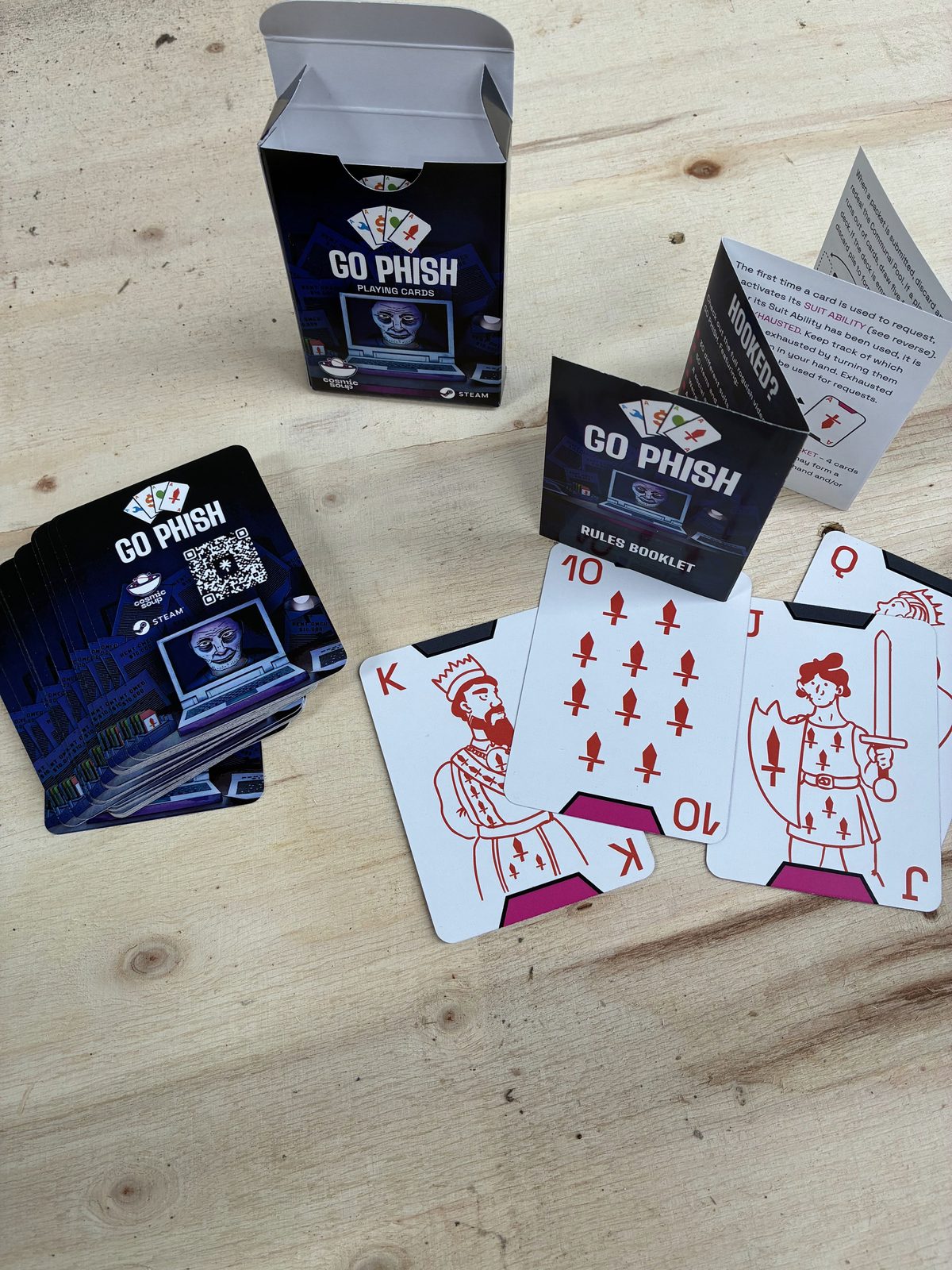
A 52-card deck with custom phishing suits, a printed tuck box and a folded rules booklet — physical merch for an Aotearoa studio's Steam game, printed here in under two weeks.
Who it was for
Cosmic Soup Games is a distributed studio spread across Aotearoa. Their game GO PHISH is a card-battler roguelite on Steam — a souped-up take on Go Fish where you collect four of a kind to break through a target's firewall.
A game about a card game is an obvious candidate for a real deck. What they wanted was merch that works two ways: something a player can actually shuffle and deal with, and something that sends people back to the Steam page.
What we printed
- A 52-card deck on 300gsm stock, with custom suit symbols in place of the usual pips
- A printed tuck box with a thumb notch, in the game's dark blue and magenta palette
- A folded rules booklet explaining Suit Abilities, Exhausted cards and Packets — so the deck plays as its own game, not just a souvenir
The cards keep a conventional structure — recognisable kings, queens, jacks and numbered cards — but the suits are redrawn around the game's theme. That's a smarter decision than it looks. Anyone can pick the deck up and play a normal card game with it, while the artwork still does the job of advertising a game about phishing.
Custom suits are harder than they look
Replacing the standard pips is the kind of design choice that sounds simple and then isn't.
A ten-card has ten of the symbol on it. Every one of those is a small, repeated shape that has to stay crisp and read instantly from across a table. If the artwork is a touch too fine, or the shapes sit too close together, you get mush at print size even though it looked perfect on screen. Standard suits have been refined over centuries to survive exactly this; a new symbol hasn't.
Worth checking a proof at real size before committing to a run — on screen you're looking at a shape four times bigger than it will ever be printed.
The QR code we actually tested
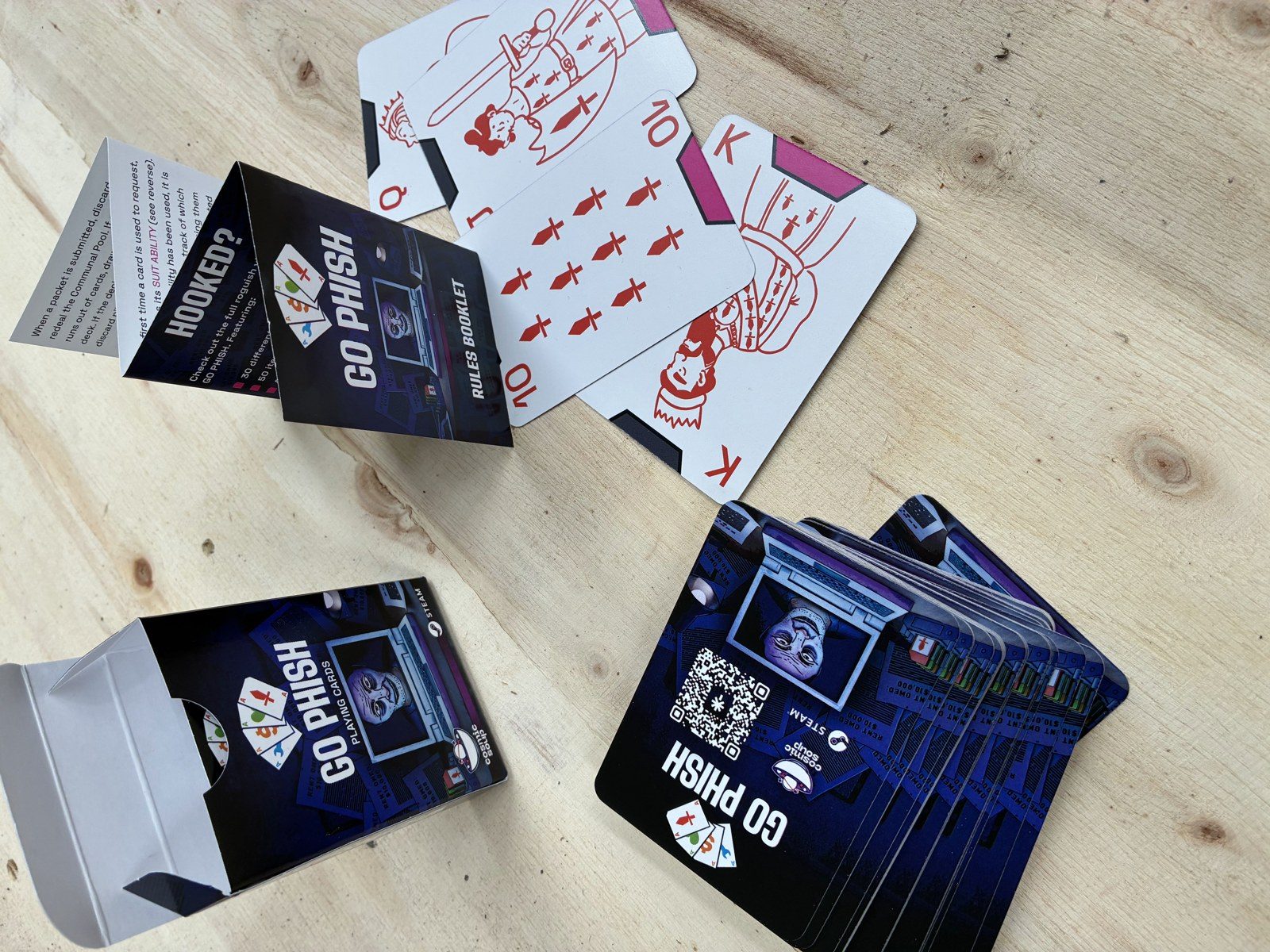
Every card back carries a QR code pointing at the game's Steam page. That's the whole commercial point of the deck — a physical object that sends someone to a digital storefront.
QR codes on dark backgrounds are the classic thing that works on screen and fails on card. Ink spreads slightly into the stock, the pale squares tighten up, contrast drops, and a code that scanned perfectly from a monitor won't scan from the printed card.
So we scanned it off the finished card before the run went out. It works.
It takes about thirty seconds, and it's the difference between a merch run that does its job and a hundred decks advertising a page nobody can reach.
The spec, and what we'd change for retail
This deck ran on 300gsm stock with a standard core and no laminate. For a short promotional run that's the right call, and we'd rather explain why than pretend everything needs the top spec.
A promo deck is handled a few times, looked at, and kept. A retail playing deck gets shuffled for hours, by people holding a hand of cards up in front of them. Those are different jobs.
If this went to a retail run, two things would change:
- Black core stock. Standard core lets a little light through when a card is held up against a window or a lamp. Nobody notices on a deck that lives in a drawer; in a card game with hidden hands, it matters.
- A laminate, most likely linen. Unlaminated cards pick up finger marks and wear at the edges once they're shuffled repeatedly. Linen also cuts glare and gives the shuffle feel people expect from a playing deck.
Neither was needed here, and adding them to a run of under a hundred would have put cost into the job without improving what the job was for. The point is knowing which run you're printing.
Merch for game studios
Physical merch is an odd fit for most printers — the quantities are small, the artwork arrives in game-engine formats, and the deadline is usually a launch or a convention.
It suits local short-run printing almost perfectly. You can print under a hundred, see them in days rather than months, and reprint once you know whether people actually want them.
See trading card printing for stocks and finishes, or game prototype printing if you're still testing a design.
Printing merch for your game?
Tell us the card count, roughly how many decks, and whether there's a box and rules to go with it. We'll quote it and tell you honestly which spec the job actually needs.
Request a quote